Physical Address
304 North Cardinal St.
Dorchester Center, MA 02124
Physical Address
304 North Cardinal St.
Dorchester Center, MA 02124

The video appeared on TikTok like something from a fever dream. An elderly woman stood on the left side of the screen, her face marked by the natural creases of 74 years of life. On the right, just days later according to the caption, stood what appeared to be the same person—except her skin was stretched impossibly tight across her skull, her eyes widened to an almost cartoonish degree, her features pulled back in a way that made viewers instinctively uncomfortable.
“74 years old,” the caption read in broken English. “She doesn’t look bad at all for 74. If she walks down the street with her daughter, she is like her sister.”
The comments section exploded.
“She looks like a robot wearing human skin.”
“This has to be AI. This can’t be real.”
“Her soul looks trapped in a body that can’t move.”
But it was real. Horrifyingly, disturbingly, undeniably real. And this was just one video from an account that would soon become one of the most talked-about and feared names in plastic surgery social media: Dr. Kim.
By early 2024, the TikTok account @jiezou16 had amassed over 130,000 followers and 2.5 million video likes. In just seven months since the first post appeared in June 2023, “Dr. Kim” had become a viral phenomenon—but not in the way most cosmetic surgeons would want.
The videos followed a disturbing pattern. An older person would appear on screen, their face showing normal signs of aging. Then, in a jarring cut, the same person would appear just days after surgery—their face transformed into something that viewers struggled to define. Younger? Perhaps. Human? Debatable.
A 46-year-old woman became “a little girl” with eyes unnaturally larger, skin stretched smooth, and ears pinned at odd angles causing the lobes to bulge outward. A 51-year-old man from Spain appeared with his face pulled so tight that viewers wondered if he could still make facial expressions. A 58-year-old woman’s transformation left people asking if she could even close her eyes.
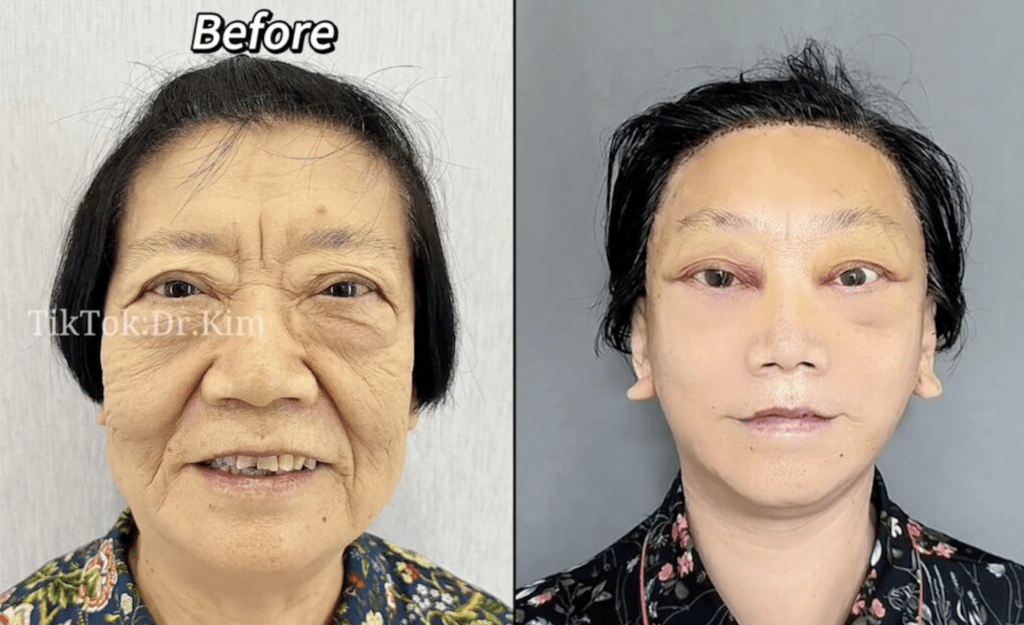
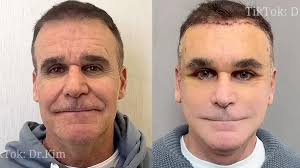
The medical community watched in horror. Board-certified plastic surgeon Dr. Anthony Youn examined the videos and called them “extreme.” Dr. Richard J. Brown warned about the surgical techniques on display, particularly the forehead incisions visible across many patients’ foreheads, which he said could be extremely visible and not look great long term.
But perhaps most disturbing was the phrase that kept appearing in the comments, repeated thousands of times: “Uncanny Valley.”
The uncanny valley is a concept from robotics and animation—the idea that as something becomes more human-like but not quite human, it triggers a feeling of revulsion and unease. It’s why some CGI characters or hyper-realistic dolls make us deeply uncomfortable. They’re close enough to human to fool our brains momentarily, but just wrong enough to set off alarm bells.
Dr. Kim’s patients had fallen into this valley.
Their faces were smooth—too smooth. Their eyes were open—too open. Their skin was tight—impossibly tight. They looked younger in the way a mannequin looks younger than a real person. Ageless not through vitality but through the eerie stillness of something that has been frozen in time.
In some videos, patients appeared to be shaking or twitching after surgery, leading viewers to wonder what exactly had been done and whether they could still close their eyes. The transformations weren’t subtle refinements or natural-looking rejuvenation. They were radical alterations that seemed to strip away not just wrinkles but humanity itself.
One commenter captured the collective horror: “They look like their souls are trapped in bodies that can’t move.”
As the videos went viral—some accumulating millions of views—people began asking the obvious question: Who is Dr. Kim?
The answer was both simple and impossibly complicated.
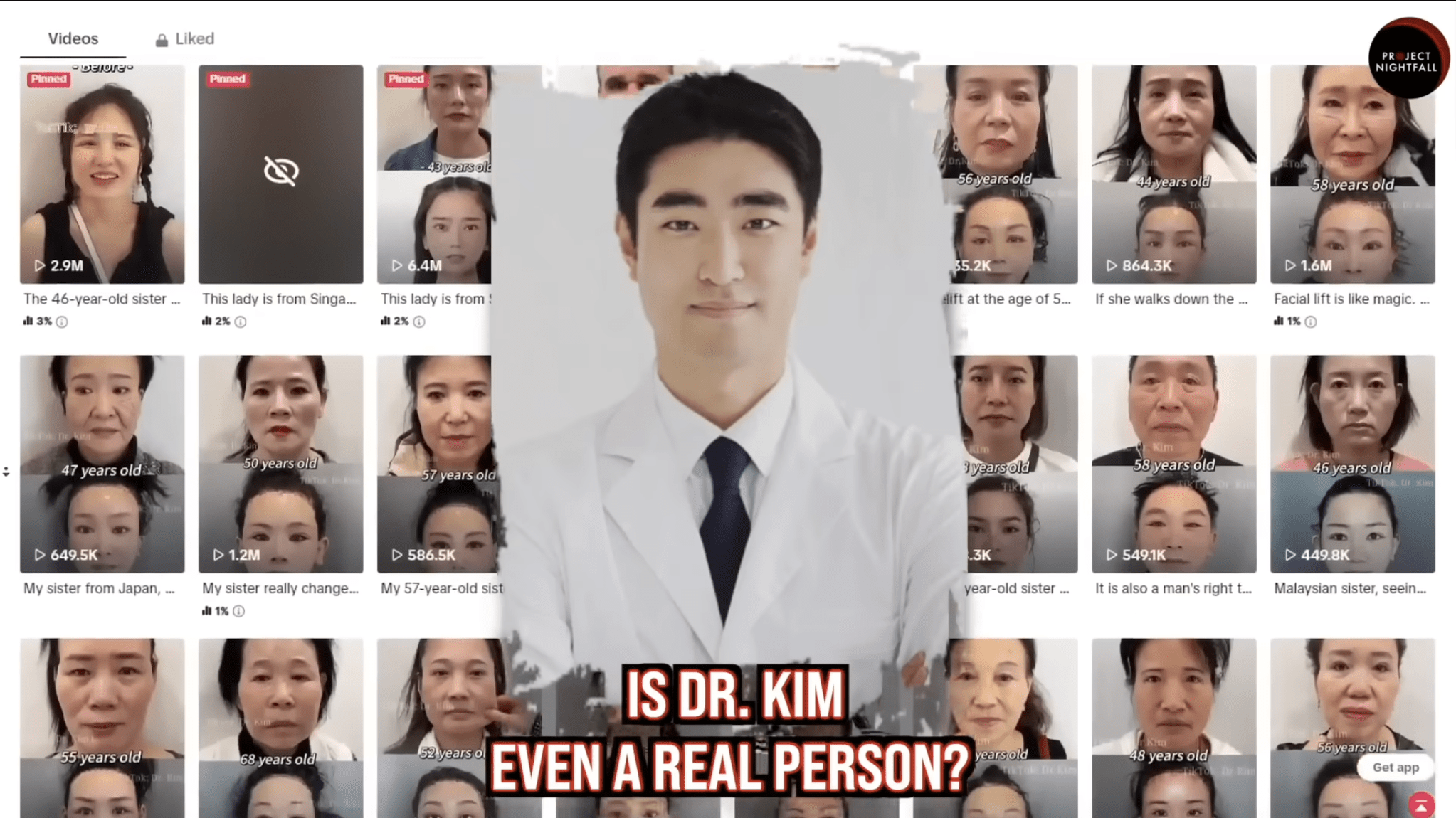
The TikTok bio was blank. No credentials. No location. No information whatsoever. Just a WhatsApp number and a website link that, when clicked, led nowhere. The website www.gjhos.com wasn’t live and appeared never to have been, according to internet archives.
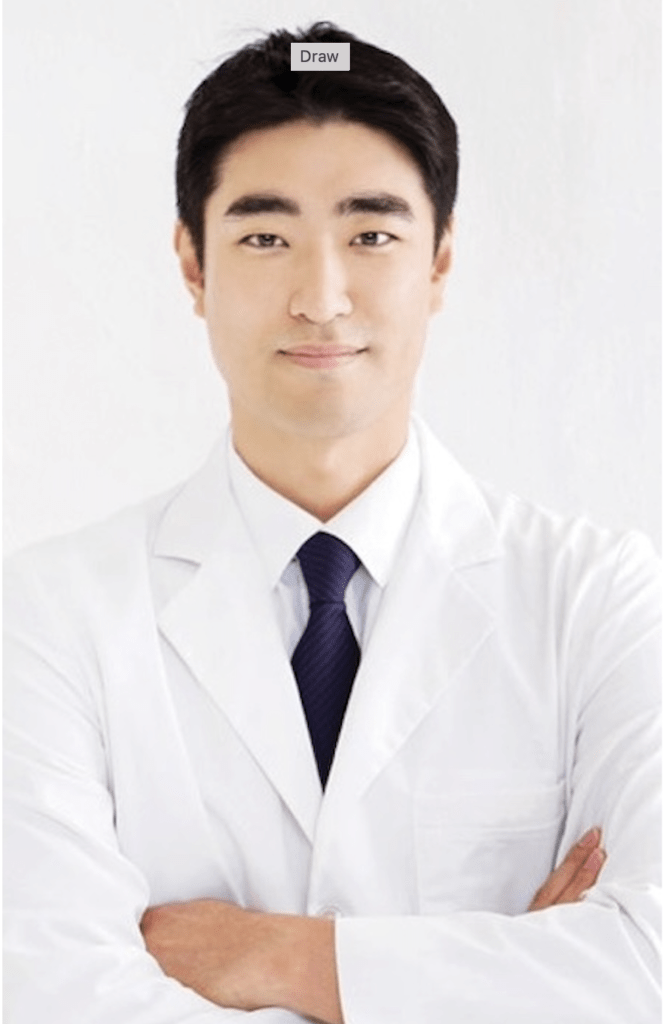
The profile picture showed an older Asian man in medical attire. It looked professional, official, legitimate. Except reverse image searches suggested it might just be a stock photo. One TikTok investigator quipped it looked like someone had simply searched for “doctor picture” on Google and picked the first generic result.
When journalists reached out via WhatsApp, things got stranger. An account manager replied saying procedures cost around $50,000 and directed interested parties to “Shanghai, China. Cash, anytime.” Yet reverse-image searches of the profile picture suggested the surgeon’s name was Kim Ji-hoon from South Korea. When reporters tried to contact a Dr. Kim Ji-hoon in South Korea, they received no response.
So was Dr. Kim in China or Korea? Was he even real? The rabbit hole was about to get much deeper.
Enter Tuv, a YouTuber who decided to investigate the mysterious surgeon. What he uncovered was a labyrinth of fake identities, duplicate accounts, and shadowy connections that painted a picture far more sinister than a single controversial doctor.
Tuv’s investigation revealed that the @jiezou16 account (Dr. Kim) and another account called “liangauxsr2” both had links in their bios that led to the same WhatsApp account, named “Jiezou -Gj”. The same username. The same contact information. Two different “doctors.”
But it didn’t stop there. Tuv discovered multiple TikTok accounts posting similar content with similar backgrounds:
The Facebook trail led to a clinic location in Shanghai and yet another doctor named “Li Feng” (sometimes written as “Li Fun” or “Leun”).
When Tuv posed as a potential patient and contacted the WhatsApp number asking for Dr. Kim specifically, the account responded. But here’s where it gets truly bizarre: when asked about the surgeon who would perform the operation, they didn’t say Dr. Kim. They didn’t say Dr. Liang. They mentioned Dr. Leun—yet another name in this growing list of phantom surgeons.
The evidence pointed to a disturbing conclusion: there might be only one surgeon operating under multiple fake identities, using different TikTok accounts to cast a wider net for victims. Or perhaps a small team of surgeons all operating from the same Shanghai clinic, cross-promoting each other’s work under various pseudonyms.
Who falls for this? Who would travel to China, carry $50,000 in cash, and let a surgeon with no verifiable credentials perform extreme facial surgery?
The answer is heartbreaking: the desperate and the hopeful.
Many of Dr. Kim’s patients were older individuals from countries where such procedures would cost far more or require extensive medical scrutiny. The captions on the TikTok videos ranged from “the 46 year old sister turns into a little girl after facial lift” to “It is also a mans right to love beauty. My 58 year old brother has a very good facelift effect”—pure manipulation designed to make people believe they could reclaim their youth.
One particularly tragic caption revealed: “A 76-year-old aunt had a face lift… Aunt said it was the most important change in her life.”
These weren’t wealthy socialites seeking minor tweaks. These were everyday people—a nanny from Indonesia who saved a year’s salary to afford the procedure, a Spanish man who traveled across the world, elderly women convinced this was their last chance to feel beautiful again.
The operation is cynical in its sophistication. By posting dramatic before-and-after videos, Dr. Kim (or whoever was behind these accounts) created a portfolio that simultaneously attracted and repelled viewers. The videos went viral because they were shocking, and that virality brought them to the attention of exactly the people they were targeting: older individuals scrolling through social media, seeing these dramatic transformations, and thinking, “Could that be me?”
The promise was seductive: look 10, 20, even 30 years younger. Be mistaken for your daughter’s sister. Turn back time. Reclaim what age had stolen.
The reality was horror.
What exactly does Dr. Kim do to achieve these results? Medical professionals who’ve examined the videos have identified several concerning techniques.
The most visible is the pretrichial or front-of-hairline incisions that run across the entire width of patients’ foreheads. In the immediate post-operative videos—typically shot just 5-7 days after surgery—these incisions are clearly visible, along with extensive stitching. These types of incisions, multiple surgeons have warned, can leave permanent scarring that remains highly visible long-term.
But the incisions are just the beginning. To achieve the extreme skin-tightening effect seen in the videos, surgeons would need to remove significant amounts of tissue and pull the remaining skin taut to an extreme degree. This explains why patients’ eyes appear unnaturally large and wide—the skin around the eyes has been pulled so tight that the eyelids can no longer fully close normally.
The ear positioning in many patients is also troubling. Ears appear pinned at the vertical center, causing the lobes to bulge outward at unnatural angles. This suggests the facial skin has been pulled back with such force that it’s literally dragging the ears along with it.
Multiple viewers and medical professionals have noted that some patients in the videos appear to be shaking or twitching, raising questions about nerve damage or other complications.
And then there’s the question that haunts every video: can these people close their eyes? Can they smile? Can they make normal facial expressions, or has their face been turned into a rigid mask that can only approximate human emotion?
The videos never show the answers. They’re carefully edited to show only specific angles, only certain expressions. What happens when the camera stops rolling? What do these people see when they look in the mirror a month later, a year later, when the swelling finally goes down and they’re left with the permanent reality of what’s been done to their faces?
Perhaps most troubling is that despite the overwhelming negative reaction online, some people defend the results.
Scroll through the comments on Dr. Kim’s videos and between the horror and mockery, you’ll find another voice: older people saying they want these procedures. People asking for contact information. People saying the results look “quite worth it.”
While significant portions of the TikTok audience describe the patients as resembling horror movie characters, Dr. Kim’s patients don’t necessarily share the perspective that their surgeries were “botched”. Some have given testimonials claiming satisfaction. Whether this is genuine or coerced, whether it’s the result of cognitive dissonance or legitimate preference, is impossible to know.
The debate has divided even medical professionals. Some argue that if patients are happy with results, who are we to judge? Others point out that these videos show patients in the immediate post-operative period—swollen, bruised, still healing—and may not represent the final results.
But Dr. Anthony Youn, a board-certified plastic surgeon with a large social media following, put it bluntly when examining Dr. Kim’s work: “Plastic surgery coming out of Asia is so extreme it makes me sad.”
In February 2024, the original @jiezou16 Dr. Kim account was banned and removed from TikTok. The videos that had terrified and fascinated millions simply disappeared.
But the story didn’t end there. Other accounts remained live, still posting similar content, still using the same contact information. The operation continued, just under different names, different handles, different fronts.
This is the truly insidious part of the Dr. Kim phenomenon. It’s not one person. It’s a system. A network of fake identities, recycled content, and coordinated marketing designed to funnel vulnerable people toward a clinic (or clinics) in Shanghai where they’ll undergo extreme procedures for cash payment, no questions asked, no real accountability.
When one account gets banned, another pops up. When one name becomes too associated with controversy, they rotate to another. Dr. Kim becomes Dr. Liang becomes Dr. Leun becomes Dr. Sam. The faces change but the operation remains the same.
Who is really performing these surgeries? Is it one surgeon? A team? Are they even qualified plastic surgeons or simply individuals with medical training willing to perform extreme procedures for the right price?
What happens to the patients after the videos stop? Do their faces eventually heal to look more natural, or are they left with permanent disfigurement? Do they regret their decisions, or do they genuinely believe they look better?
Where exactly is this clinic? The WhatsApp account directs people to Shanghai, but that’s a city of over 24 million people. Without a specific address, without verifiable credentials, patients are essentially agreeing to meet a stranger in a foreign city and undergo irreversible facial surgery.
What happens if something goes wrong? If a patient experiences complications, infections, or severe dissatisfaction, what recourse do they have? They paid cash to an untraceable surgeon in a foreign country. There are no medical boards to complain to, no licensing authorities, no legal framework for accountability.
And perhaps most hauntingly: how many people have actually gone through with these procedures? The TikTok account shows about 90 patients in its videos. But how many others weren’t filmed? How many people are walking around right now, living with the results of Dr. Kim’s work, their faces permanently altered by a surgeon whose real identity remains unknown?
The Dr. Kim phenomenon isn’t just about one controversial surgeon or group of surgeons. It’s a mirror reflecting the darkest aspects of the plastic surgery industry and our culture’s obsession with youth.
The legitimate plastic surgery industry is worth billions of dollars globally, built on the promise that physical transformation can bring happiness, confidence, and social acceptance. When performed ethically by qualified surgeons on carefully screened patients with realistic expectations, plastic surgery can indeed improve people’s lives.
But Dr. Kim’s operation exists in the shadows of that industry—a predatory ecosystem that preys on people’s insecurities and desires. It’s medical tourism at its most exploitative, offering dramatic results at cut-rate prices with no accountability.
The videos themselves are marketing genius in a twisted way. By being shocking enough to go viral, they reach millions of people organically. Most viewers are horrified, but buried in those millions are the vulnerable few who see not horror but hope. That’s all the operation needs to succeed.
Social media platforms have become the perfect hunting ground for this kind of predatory practice. Traditional advertising would never allow such graphic medical content or unverified medical claims. But on TikTok, Instagram, and other platforms, anyone can post anything, and if it goes viral, it reaches more eyes than any paid advertisement ever could.
In the months since Dr. Kim first went viral, the internet has been flooded with reaction content, parody videos, and debates about medical ethics. The term “Dr. Kim” has become shorthand for plastic surgery gone horribly wrong, a cautionary tale shared in memes and TikTok trends.
But while the internet mocks and creates content, real people are still seeking out these procedures. The WhatsApp number still works. The other accounts still post. The operation continues.
And every day, someone somewhere scrolls through social media, sees one of those dramatic before-and-after videos, and thinks: “Maybe that could be me. Maybe I could look young again. Maybe this is worth the risk.”
That’s what makes this story so dark. It’s not just about bad surgery or questionable ethics. It’s about the systematic exploitation of human vulnerability, packaged in viral videos and delivered through an algorithm that doesn’t care about the consequences.
Medical professionals and investigators have identified several red flags that should immediately alert people to predatory plastic surgery operations:
No verifiable credentials or licensing information. Legitimate surgeons are proud of their qualifications and make them easily accessible. If you can’t find solid evidence of medical training and board certification, run.
Cash-only payment, especially in foreign countries. This makes the transaction untraceable and leaves you with no recourse if something goes wrong. Legitimate medical facilities accept various forms of payment and provide detailed billing.
Prices far below market rate. If something seems too good to be true, it probably is. Qualified surgeons charge market rates because they have expensive insurance, facility costs, and years of training to recoup. Extreme discounts often mean cut corners.
Unwillingness to provide references or detailed information. When journalists contacted Dr. Kim’s team asking for details about the procedures, some answers were delayed by days and basic information was withheld. Real medical practices want to answer your questions.
Multiple identity confusion. The existence of multiple names and accounts all leading to the same contact point is a massive red flag. Legitimate surgeons don’t need to hide behind fake identities.
Pressure to act quickly. Predatory operations often create artificial urgency. Legitimate surgeons encourage patients to take time, think carefully, get second opinions.
Results that look “too good” or unnatural. If the before-and-after photos make you uncomfortable, trust that instinct. Natural-looking results should be the goal, not radical transformation.
Behind every viral video, every shocking transformation, every click and share, there’s a real person who will live with the consequences forever.
Think about the 76-year-old woman who told her family this was “the most important change in her life.” What did she see when she looked in the mirror afterward? Did she see the youth she’d been promised, or did she see a stranger staring back at her? What did her family say when they saw her? What did her friends think?
Consider the nanny from Indonesia who saved for an entire year to afford this procedure. What happened when she returned to work? Could she even return to work? How do you explain to an employer that you suddenly look completely different, that you paid a mysterious surgeon in China $50,000 to remake your face?
Think about the 51-year-old man from Spain, whose video became one of the most viral. The comments were brutal: “Dr Kim, imma need you to turn yourself in now,” liked by tens of thousands of people. Imagine knowing that millions of people around the world have seen your face and reacted with horror, disgust, fear. How do you process that? How do you live with that?
These aren’t characters in a horror story. They’re real people who made decisions based on hope and desperation, who trusted a stranger with their faces, who believed the promises they were sold. And now they live with faces that make strangers uncomfortable, that inspire parody videos and internet memes, that will be associated with the phrase “uncanny valley” for years to come.
Dr. Youn, a prominent plastic surgeon on social media, posed this question when examining Dr. Kim’s work: “How much is too much in plastic surgery?”
It’s a question the industry struggles with. Where’s the line between enhancement and disfigurement? Between helping someone look their best and creating something unnatural? Between giving patients what they ask for and protecting them from their own unrealistic expectations?
In South Korea, where plastic surgery is more culturally accepted and common than perhaps anywhere else in the world, the industry has still developed ethical guidelines and standards of care. Surgeons are expected to refuse patients whose expectations are unrealistic or whose desired results would look unnatural.
Dr. Kim’s operation appears to have no such limitations. If you have the money and you’re willing to sign whatever waiver they put in front of you, they’ll give you the radical transformation you think you want.
But wanting something and it being good for you are very different things. And there’s a reason why ethical medical practice includes the principle of “first, do no harm.” Sometimes the best thing a doctor can do is say no.
Here’s perhaps the darkest truth about the Dr. Kim phenomenon: social media algorithms don’t distinguish between horror and hope, between warning and advertisement, between educational content and predatory marketing.
When Dr. Kim’s videos went viral, TikTok’s algorithm saw engagement. It saw people watching, commenting, sharing. It saw videos that kept people on the platform. So it showed the videos to more people. And more people. And more people.
Some of those people shared the videos as cautionary tales. Some created reaction content mocking the results. Some used the videos as examples of what not to do. But others—the ones Dr. Kim’s operation was really targeting—saw the videos and saw possibility.
The algorithm can’t tell the difference. It just knows the videos are getting views, so it keeps pushing them out into the world, onto more “For You” pages, in front of more vulnerable eyes.
This is the machine logic of social media: engagement is engagement, regardless of whether that engagement is positive or negative, helpful or harmful, protective or predatory. The videos that shock us the most are often the videos that spread the furthest.
As of early 2024, the original Dr. Kim account had been banned from TikTok. But related accounts remain active. The WhatsApp number still works. The operation continues, just under different names, different platforms, different disguises.
So what’s the solution? How do we protect vulnerable people from predatory medical tourism while respecting individual autonomy and cultural differences in beauty standards?
Some argue for stricter regulation of medical content on social media platforms. Perhaps before-and-after surgical photos should require verification of the surgeon’s credentials. Perhaps claims about surgical results should be subject to the same scrutiny as other medical advertisements.
Others advocate for better consumer education about the risks of medical tourism and how to identify legitimate versus predatory surgical practices. If people are going to seek these procedures anyway, at least arm them with the knowledge to make safer choices.
Still others believe the answer lies in addressing the root cause: the cultural obsession with youth and the stigma against aging that makes people desperate enough to risk everything for a younger-looking face. If we could create a society that valued aging as a natural, beautiful process rather than something to be feared and corrected, perhaps the Dr. Kims of the world would lose their market.
But the reality is that none of these solutions will be implemented quickly or completely. And in the meantime, the videos keep spreading, the accounts keep posting, and people keep booking flights to Shanghai carrying bags of cash and dreams of transformation.
Imagine for a moment that you’re one of Dr. Kim’s patients. The surgery is over. The initial swelling has gone down. You stand in front of a mirror and look at your new face for the first time.
What do you see?
Do you see the youth you paid for, the transformation you dreamed about? Or do you see something else—something that looks almost like you but not quite, something that moved into the uncanny valley and can’t find its way back out?
Your eyes are wider now, permanently startled-looking. Your skin is tight, so tight you can feel it pulling when you try to smile. The scars across your forehead are fading but they’ll never fully disappear. Your ears sit at a slightly different angle than they used to. When you try to close your eyes all the way, you can’t quite do it anymore.
You look younger, technically. The wrinkles are gone. But you also look… wrong. Not quite human. Like a mask pulled too tight over your skull.
And you realize, in that moment staring at your reflection, that this is forever. This is your face now. This is what you’ll see every time you look in a mirror, every time you see a photograph, every time you catch your reflection in a window or screen. This is the face your family will see, your friends will see, strangers will see.
This is the face you paid $50,000 for. This is the face you traveled across the world for. This is the face a mysterious surgeon in Shanghai gave you, and now he’s vanished back into the internet, untraceable, unaccountable, and there’s nothing you can do to undo what’s been done.
That’s the true horror of the Dr. Kim story. Not the dramatic videos or the viral controversy or the online debate. But the moment when the camera stops rolling and a real person has to live with the consequences of trusting a phantom surgeon with their face.
Who is Dr. Kim? We may never truly know.
Is he Kim Ji-hoon from South Korea? Is he Li Feng from Shanghai? Is he one person using multiple identities, or multiple people working together? Is “Dr. Kim” even a real surgeon, or just a marketing persona for a clinic that rotates through different doctors?
The questions pile up like the fake names and duplicate accounts. But perhaps the most important question isn’t “who” but “why.” Why does this operation exist? Why does it work? Why do people keep falling for it?
The answer is both simple and heartbreaking: because getting old is scary, and looking old in a culture that worships youth is scarier still. Because we’ve been told our whole lives that our worth is tied to our appearance, and as that appearance fades, we panic. Because the promise of turning back time, of looking in the mirror and seeing our younger selves again, is so seductive that some people will risk anything for it.
Dr. Kim—whoever he really is—understood this. He understood that desperation creates vulnerability, and vulnerability creates opportunity. He understood that social media has created a new marketplace for predatory medical practices, where viral videos can reach millions and algorithms don’t care about ethics or consequences.
He understood that in the attention economy, even horror can be advertising. That the same videos that make most people recoil will make a few people hopeful. And those few people are enough.
If you take nothing else from this story, take this: your face is not a commodity to be traded to the lowest bidder. Your appearance is not a problem that needs a radical solution. And the promise of looking decades younger overnight is exactly that—a promise, made by people who disappear when it’s time to deal with reality.
There are legitimate, qualified, ethical plastic surgeons around the world who can help people achieve natural-looking results that enhance rather than erase their features. They have verified credentials, traceable locations, transparent pricing, comprehensive consultations, and a commitment to patient safety and realistic expectations.
They also won’t promise to turn you into “a little girl” or make you unrecognizable to your own family. Because that’s not medicine. That’s not surgery. That’s something else entirely—something dark and predatory that wears the costume of medical care while being fundamentally opposed to its core principles.
The Dr. Kim phenomenon is a warning about what happens when medical practice meets social media marketing meets human desperation. It’s a cautionary tale about the dangers of medical tourism, the predatory nature of some beauty industry practices, and the way viral content can spread harm while pretending to offer hope.
But most of all, it’s a reminder that your face is your own. It tells the story of your life, your experiences, your years. And while there’s nothing wrong with wanting to look your best or address legitimate concerns about your appearance, there’s everything wrong with trusting a phantom surgeon who promises miracles and delivers nightmares.
The videos will keep circulating. The accounts will keep posting. The operation will continue, because as long as there are people afraid of aging and willing to take desperate chances, there will be someone ready to exploit that fear.
But you don’t have to be one of them.
You can see the before-and-after photos and recognize them for what they are: not aspirations but warnings. You can hear the promises of radical transformation and understand that radical often means irreversible and unrealistic. You can look at those faces—stretched, altered, trapped in the uncanny valley—and make a different choice.
Because the only thing scarier than getting old is looking in the mirror one day and not recognizing the person staring back at you.
And knowing you paid someone to make you that way.
That’s the real horror story of Dr. Kim.