Physical Address
304 North Cardinal St.
Dorchester Center, MA 02124
Physical Address
304 North Cardinal St.
Dorchester Center, MA 02124

The remarkable tale of Jeanne de Clisson, a 14th-century noblewoman who transformed from a lady of the French court into one of history’s most feared pirates.
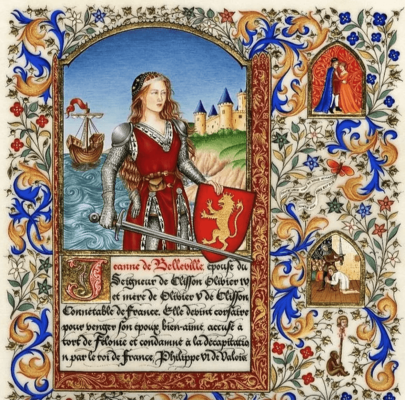
Jeanne Louise de Belleville was born around 1300 in Brittany, France, into a wealthy and powerful noble family. She was beautiful, educated, and everything a noblewoman of her era was expected to be. She married young, as was customary, first to a man named Geoffrey de Châteaubriant, with whom she had two children. After his death, she married Guy de Penthièvre, but this marriage was brief.
Her third marriage, around 1330, would change everything. She wed Olivier IV de Clisson, a wealthy Breton nobleman and a respected military commander. They had five children together and seemed to have found happiness in their castle in Brittany. Olivier was a powerful man, loyal to the French crown, and Jeanne lived the comfortable life of a high-born lady.
The year 1343 marked the turning point. France and England were locked in the Hundred Years’ War, and Brittany was caught in a brutal succession conflict. Olivier de Clisson was fighting for the French king, Philip VI, in this chaotic war.
During a tournament, Olivier was accused of treason—allegedly plotting to sell the strategically important city of Vannes to the English. The evidence was flimsy at best, possibly fabricated by jealous rivals at court. Despite his protests of innocence and his years of loyal service, King Philip VI had him arrested.
Olivier was given a show trial in Paris, where he was swiftly found guilty. Jeanne rushed to Paris, desperately trying to save her husband. She pleaded with the king, used all her connections, offered money, begged for mercy. But Philip VI was unmoved. On August 2, 1343, Olivier de Clisson was beheaded in front of a jeering crowd.
But the cruelty didn’t end there. In a display meant to serve as a warning to others, Olivier’s body was drawn and quartered, and his head was sent to Nantes to be displayed on a spike at the city gates as a traitor.
Jeanne was devastated, but devastation quickly turned to rage. She was absolutely convinced of her husband’s innocence and saw his execution as a monstrous injustice. The noblewoman who had begged the king for mercy was gone, replaced by something far more dangerous.
Jeanne made a vow: she would have her revenge on the King of France and every noble who had betrayed her husband. She would make Philip VI regret the day he ordered Olivier’s death.
She sold all her estates and used her considerable fortune to raise a small army. Then she did something extraordinary—she took her two eldest sons to see their father’s head mounted on the city gate. There, she made them swear an oath of vengeance against the French crown. It was a moment of such intensity that it would fuel her actions for the next thirteen years.
Jeanne began her campaign of vengeance on land, attacking French forces and nobility in Brittany with her small army. But she quickly realized that to truly hurt the French king, she needed to strike where it would cause the most economic damage—at sea.
She commissioned three warships, painting them completely black with red sails, earning her fleet the ominous nickname “The Black Fleet.” The flagship was called “My Revenge.” These weren’t ordinary ships—they were sleek, fast vessels designed for one purpose: hunting French ships.
Jeanne herself sailed with her fleet, sword in hand. She reportedly wore her hair loose and wild, abandoning the proper headdresses of noblewomen. She was no longer Lady de Clisson; she was the Lioness of Brittany, and she was out for blood.
For thirteen years, from 1343 to 1356, Jeanne and her Black Fleet terrorized the English Channel and the waters around Brittany. She hunted French merchant vessels and naval ships with ruthless efficiency. When she captured a French ship, she would kill nearly everyone aboard, leaving only two or three survivors to sail back to France with a message for the king: this was revenge for Olivier de Clisson.
Her tactics were brutal and calculated. She specifically targeted French nobility, showing them the same mercy they had shown her husband—none. She reportedly killed nobles with an axe herself, a visceral and personal form of vengeance that struck terror into the hearts of French sailors.
The French fleet tried repeatedly to stop her but failed. Jeanne knew the waters around Brittany intimately, and her ships were faster and better crewed. She had also formed an alliance with Edward III of England, France’s enemy, who was happy to support anyone causing problems for the French king. England provided her with protection, supplies, and safe harbors.
Stories of the Black Fleet spread throughout France. Merchants refused to sail without heavy escort. The sight of black sails on the horizon sent French ships fleeing. Jeanne de Clisson had become a legend and a nightmare.
What made Jeanne different from other pirates and privateers of her era was the personal nature of her campaign. This wasn’t just about profit or politics—it was about grief and rage transformed into action. She never forgot why she was doing this. Every French noble she killed, every ship she burned, was for Olivier.
She also showed surprising mercy to non-French sailors and to commoners. Her vengeance was directed specifically at the French nobility and crown. English, Breton, and other sailors captured on French vessels were often released unharmed.
Around 1356, after thirteen years of piracy, Jeanne’s campaign began to wind down. King Philip VI had died in 1350, taking away some of the personal edge from her revenge. She was also getting older and had achieved what she set out to do—she had made the French crown pay dearly for her husband’s execution.
She eventually remarried, surprisingly to an Englishman named Sir Walter Bentley, a lieutenant of the English king in Brittany. She spent her later years in relative peace, finally hanging up her sword and axe.
Jeanne de Clisson died around 1359, probably in her late fifties or early sixties. By medieval standards, especially for someone who had lived such a violent life, this was a respectable age.
Jeanne de Clisson’s story is remarkable because it defies everything we expect from a medieval noblewoman. In an era when women were expected to be passive, decorative, and obedient, Jeanne raised an army and a fleet, became a feared naval commander, and personally fought in battles. She transformed grief into action and became one of the most successful pirates in history.
Her story also speaks to the injustices of medieval politics, where a loyal nobleman could be executed on flimsy evidence, and how that injustice could spark a campaign of revenge that lasted over a decade and cost the French crown dearly in ships, lives, and prestige.
The Lioness of Brittany remains one of history’s most fascinating figures—a woman who refused to accept her husband’s wrongful death, who took up the sword herself, and who made kings and nobles fear the sight of black sails on the horizon.