Physical Address
304 North Cardinal St.
Dorchester Center, MA 02124
Physical Address
304 North Cardinal St.
Dorchester Center, MA 02124

Let me tell you a story from the summer of 1514, when the fields of Hungary ran red with blood and a man sat upon a throne that burned like the sun itself.
In the hills of Transylvania, in a village called Dálnok, there lived a boy named György Dózsa. He was born around 1470 into the Székely people—fierce Magyar warriors who guarded Hungary’s eastern frontier in exchange for their freedom. While other peasants bent their backs in the fields, chained to the land by law and custom, the Székelys rode as free men, their swords always ready for the Turkish raiders who came from the south.
Young György grew into a formidable fighter. He learned the art of war on the brutal frontier where the Ottoman Empire pressed against Christian Europe. His sword tasted Turkish blood many times, and stories of his courage spread. He rose to become a minor nobleman, a knight even, which was remarkable for someone of his origins. The great lords noticed him. He was brave, he was skilled, and he knew how to lead men in battle.
But György Dózsa could never forget where he came from. He had seen the vast estates of the magnates, worked by thousands of serfs who lived like animals. He knew that while he had escaped through warfare, millions of his fellow Hungarians lived in chains.
In 1514, Pope Leo X in distant Rome declared a crusade against the Ottoman Turks. The infidels were at the gates of Europe, he said, and all Christian men must take up arms to drive them back.
In Hungary, the task of organizing this crusade fell to Cardinal Tamás Bakócz, the Archbishop of Esztergom—the most powerful churchman in the kingdom. Bakócz was a bitter man. He had recently traveled to Rome hoping to be elected Pope, but the cardinals had rejected him. Now he would restore his glory by leading a great army against the Turks.
In the spring of 1514, Bakócz’s preachers spread across Hungary. In every village square, they proclaimed the Pope’s crusade. “Join us,” they cried, “and your sins will be forgiven! Join us, and you will be free from your masters for the duration of the holy war!”
Free. That single word echoed like thunder across the Hungarian plains.
Peasants who had never been allowed to leave their lords’ estates could now walk away legally. Serfs who had been beaten and starved and worked until their hands bled could escape their masters by taking up the cross. It was a miracle, a gift from God himself.
They came by the thousands. Then by the tens of thousands. They poured out of the villages and towns—peasants with farming tools, poor townsfolk with kitchen knives, students with books still in their packs, even some lower clergy. They brought their rage and their hope, and they looked for someone to lead them.
György Dózsa was chosen as one of the crusade’s military commanders. Here was a man who knew war, who had proven himself against the Turks. He would lead these ragged masses to glory.
But as April turned to May, and the crusader army swelled to perhaps 100,000 souls, the Hungarian nobility looked upon this gathering host with horror.
“Who will plant our fields?” they asked. “Who will tend our livestock? These peasants belong to us!”
More than that, they saw something terrifying: an armed peasant army, growing larger every day. What if these serfs decided they liked being free? What if they decided they didn’t want to go back?
The nobles pressured King Vladislaus II, that weak and pliable ruler who bent to every wind. In late April, the king issued his decree: the crusade was disbanded. All peasants must return to their masters immediately.
But the peasants refused.
They had been promised freedom. They had been blessed by the Church. They had left their chains behind, and they would not put them back on. Not now. Not ever.
And György Dózsa made a decision that would echo through the centuries. If the nobility would not let them march against the Turks, then the nobility itself would be their enemy.
The crusade became a revolution.
Across the Great Hungarian Plain, the revolt exploded like wildfire in a drought-stricken forest. Dózsa’s army swept from town to town, and everywhere they went, the old order collapsed.
They burned the manor houses where the nobles had lived in luxury. They tore down the castles where lords had hidden behind stone walls while peasants starved. They killed—oh, they killed with a rage born of centuries of oppression. Nobles and their families, estate managers, anyone who had wielded power over the peasantry.
Some of Dózsa’s followers called him their king. This was more than a revolt now—it was a dream of a new world, a kingdom without nobles, where the land belonged to those who worked it.
György Dózsa led them with the skill of a trained commander. His peasant army won battle after battle against smaller noble forces. They captured towns. They recruited more followers. The revolution seemed unstoppable.
In May, they laid siege to Temesvár, a great fortress city defended by István Báthory. If Temesvár fell, all of Hungary might follow.
But the Hungarian nobility was not finished. They were the warrior class, trained from birth in warfare. They commanded professional soldiers, heavy cavalry in armor, men who had spent their lives learning to kill.
John Szapolyai, the Voivode of Transylvania, assembled a real army—disciplined, well-equipped, and led by experienced commanders. In July, he marched to relieve Temesvár.
The battle was a slaughter.
Dózsa’s peasants, for all their numbers and their courage and their rage, were farmers with pitchforks facing knights on horseback. They broke. They ran. And the nobles’ cavalry cut them down by the thousands as they fled.
György Dózsa was captured alive. So was his brother Gergely. So were the other leaders of the revolt.
The nobles could have simply hanged them. A quick death, a warning to others, and the matter would have been finished.
But that was not enough. Not nearly enough.
They brought György Dózsa to Temesvár in chains. In the city square, before a crowd forced to watch, they prepared his execution.
But first, they prepared his coronation.
The nobles had decided that since this peasant had pretended to be a king, they would crown him as one.
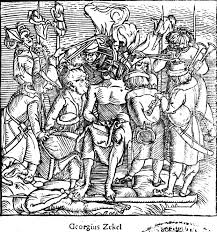
They built a throne of iron and placed it in a great fire until the metal glowed red like the heart of Hell itself. They forged a crown of iron and heated it until it shimmered with terrible heat. They made a scepter of iron and thrust it too into the flames.
Then they brought György Dózsa forward.
Imagine it: the summer heat, the crowd held back by soldiers, the stench of burning charcoal and hot metal. And in the center, that throne radiating waves of heat so intense you couldn’t stand near it.
They forced him onto that burning throne.
The flesh of his back and legs began to sizzle and char immediately. The pain must have been beyond comprehension, beyond anything a human mind was meant to endure. But the accounts say he did not scream. He did not beg. He sat upon that throne like a king indeed.
They placed the glowing crown upon his head. His hair caught fire. The iron burned through his scalp into the bone of his skull. Still, they say, he did not cry out.
They pressed the burning scepter into his hand. The flesh of his palm melted around the hot iron.
“Behold your king!” the nobles mocked. “Behold the King of the Peasants!”
But they were not done.
They had captured nine of Dózsa’s most loyal followers. For days, these men had been given no food, no water. They were starving, mad with thirst and hunger.
Now the nobles brought them forward and gave them a choice.
“You followed this man,” they said. “You called him your king. Now you will feast upon him.”
The starving men were told: tear the flesh from Dózsa’s body with your teeth and eat it, or you will die in ways that will make his suffering look merciful.
And György Dózsa, still alive, still conscious on that burning throne, with a crown of fire melting into his brain and a scepter of flame in his hand—György Dózsa watched as his own followers, driven by starvation and terror, approached him.
What words can describe such a moment? What human language has names for such horror?
They tore at his flesh with their teeth. They ate pieces of him while he lived.
His brother Gergely was forced to watch, and then they cut Gergely into three pieces before György’s eyes.
Only then, after all of this, did György Dózsa finally die, his body destroyed, his followers made cannibals, his revolution drowned in blood and agony.
But the nobles’ revenge did not end with Dózsa’s death. They swept across Hungary like a plague of locusts.
Seventy thousand peasants, they say. Seventy thousand men, women, and children were hunted down and executed in the months that followed. They were hanged from trees until the branches sagged. They were impaled on stakes along the roads as warnings. They were broken on wheels, their bones shattered one by one until death came as a mercy.
Villages that had supported the revolt were burned to ashes. The survivors were scattered, sold, or killed.
And then István Werbőczy, a lawyer, wrote a new law code called the Tripartitum. Though never officially enacted, it became the law of Hungary in practice.
“Perpetual servitude,” it declared. The peasants of Hungary would be forever bound to the land, forever enslaved to their masters, as punishment for their revolt. They could not leave. They had no rights. They were less than human in the eyes of the law.
This law would remain in force for over three hundred years. Three hundred years. The revolt that was meant to free the peasants had made their slavery absolute.
For centuries after, the nobles told their children about György Dózsa as a warning. He was the monster, the demon, the traitor who had led good peasants astray.
But in the villages, in the fields, in whispered conversations by candlelight, another story was told. A story of a man who had dared to fight for freedom. A man who had sat upon a throne of fire and worn a crown of agony and never once begged for mercy.
Some said the Virgin Mary herself appeared to him in his final moments, welcoming him to heaven as a martyr. Others said his ghost still walks the roads of Hungary, searching for justice that never came.
In the twentieth century, when new revolutions swept across Europe, György Dózsa was remembered again—not as a villain, but as a hero. Streets in Budapest were named for him. Statues were raised. Operas were written about his life.
And at the place where he died, where that iron throne stood in the summer of 1514, they erected a statue of the Virgin Mary. She stands there still, looking down on the spot where a peasant wore a crown of fire and changed Hungary forever.
The story of György Dózsa is a story about power and justice, about what happens when people who have nothing finally say “no more,” and about the terrible price of failed revolution. It’s a story about how far the powerful will go to keep their power, and how far the powerless will go to be free.
And it’s a story that asks us: what would you do? What would you endure? What price would you pay for freedom?
György Dózsa answered those questions with his life, and with his death, in the summer of 1514, when he sat upon a throne that burned.