Physical Address
304 North Cardinal St.
Dorchester Center, MA 02124
Physical Address
304 North Cardinal St.
Dorchester Center, MA 02124

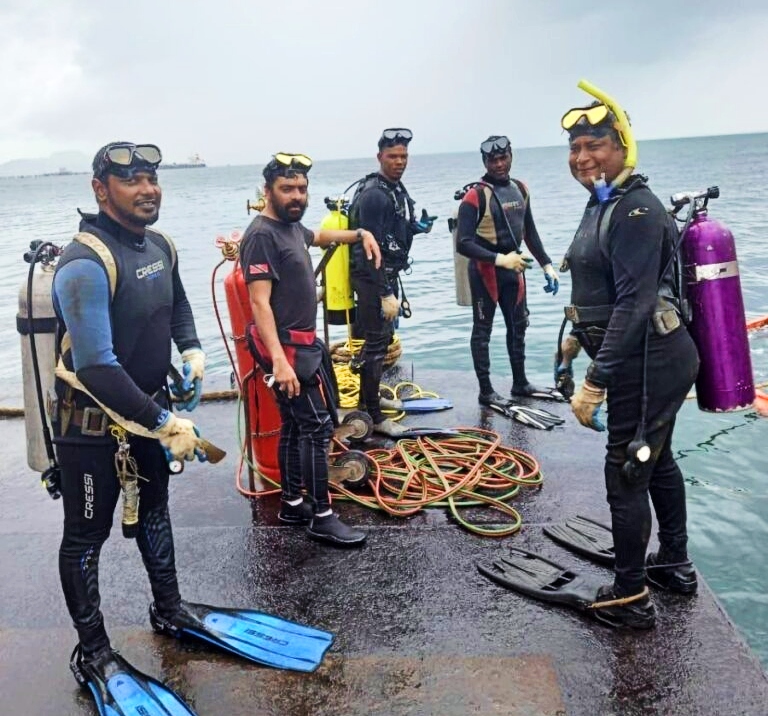
It was a Friday afternoon, February 25th, 2022, just another workday off the coast of Pointe-à-Pierre in Trinidad and Tobago. Five professional divers were working for the Paria Fuel Trading Company, doing what they’d done countless times before—maintenance work on an underwater oil pipeline.
The Team:
The crew consisted of five experienced men: Christopher Boodram, Kazim Ali Jr., Yusuf Henry, Fyzal Kurban, and Rishi Nagassar. They were employed by Land and Marine Construction Services (LMCS), contracted by Paria to repair a damaged section of pipeline. Kazim Ali Jr. was the son of the company owner. These weren’t rookies—they were professionals who knew the dangers of their trade.
The Setup:
The divers had set up a hyperbaric chamber—essentially an 8-by-8 foot underwater workspace where they could work and breathe normally while submerged. They were working on what’s called a “riser,” part of a U-shaped pipeline system where oil normally flowed from one berth to another. The pipeline had been emptied of oil nearly a month earlier in preparation for the repair work.
Around 2:45 PM that day, the men descended into the chamber to remove an inflatable plug from the pipeline—a routine procedure, or so they thought.
The Catastrophe:
What nobody realized was that when the pipeline had been cleared of oil weeks before, it had created something called “differential pressure” or “Delta P”—a deadly vacuum effect waiting to happen. As the divers removed the inflatable plug, they were suddenly sucked into a vortex that pulled them into the oil pipe.
Imagine being caught in a tornado underwater, in complete darkness. Christopher Boodram later described hitting the walls of the pipeline repeatedly, debris flying everywhere, holding his breath until his lungs screamed in agony. His eyes burned from the oil residue. It was pitch black—absolute, terrifying darkness.
Inside the Pipeline:
Miraculously, all five men initially survived being sucked into the 36-inch pipeline. They found themselves trapped in small air pockets deep inside the pipe. We know this because one diver had a GoPro camera, and the audio recording captured everything—the men could be heard praying and comforting each other.
Kurban was groaning in pain, Henry had a broken leg, and Boodram had injured his left arm. In the darkness, someone—it might have been Ali Jr.—cried out in despair. But Boodram tried to motivate them, telling them to push forward, to try to get out.
The Escape:
Christopher Boodram managed to escape by crawling down the pipe for around three hours. His colleagues, despite their own injuries, guided him in the right direction—a decision that saved his life but would haunt him forever. The other men couldn’t follow, too injured to make the agonizing crawl.
When Boodram finally reached the end of the pipe, the suction was still so powerful he couldn’t pull himself out. He grabbed onto a chain and held on desperately. Then, a hand reached down—his dive mentor, Ronald Ramoutar, who along with Corey Crawford, defied orders to pull him to safety.
The Unthinkable Decision:
Here’s where the story becomes truly heartbreaking. When Boodram surfaced around 5:45 PM, he immediately told everyone that his friends were alive, trapped in air pockets inside the pipeline. Boodram heard knocking from inside the pipeline—the men were begging for help. Rescue divers were ready and willing to go back in.
But Paria Fuel Trading Company admitted they had no rescue plan, citing that they had ‘no legal responsibility to rescue the men’. The company’s terminal operations manager, Collin Piper, refused to authorize a rescue attempt, arguing it was too dangerous and might cost more lives.
Boodram was so desperate that he tried to discharge himself from the hospital to go back and rescue his friends, but he could barely walk. When he realized they weren’t coming out, he was devastated. “Coming out that pipeline and seeing how they left us to die is worse than being in the pipeline,” he would later say.
The Wait:
For the families gathered on shore, Friday evening turned into Saturday, then Sunday. Workers from LMCS knocked on the pipeline and heard knocking back—the men were still alive. But Paria held firm. On Sunday night, February 27th, Paria announced they were switching from a rescue operation to a recovery operation—they were now looking for bodies, not survivors.
According to a second autopsy report, Kazim Ali Jr. was possibly alive for up to 39 hours after being sucked into the pipeline.
The Recovery:
On Monday, February 28th, three bodies were recovered. On Thursday, March 1st, Rishi Nagassar’s body was found. All four men—Kazim Ali Jr., Yusuf Henry, Fyzal Kurban, and Rishi Nagassar—were gone.
Why Did This Happen?
The Commission of Enquiry that investigated found that the disaster was caused by the methodology used to empty the pipeline, which created the deadly differential pressure hazard. But more than that, it was a failure of knowledge, planning, and humanity.
The Commission found in November 2023 that “Paria’s negligence could be characterised as gross negligence and consequently criminal”. They recommended corporate manslaughter charges. Both Paria and LMCS failed to recognize the Delta P hazard. Neither company had a proper rescue plan in place.
The Aftermath:
Christopher Boodram survived physically, but he’s never been the same. He can’t go to the beach anymore without seeing the berths where his friends died. He suffers from flashbacks and nightmares. In July 2024, criminal charges were filed against Paria’s general manager, operations manager, and LMCS’s head.
But for Boodram and the families, justice still feels far away. The families received no compensation, no state assistance. The $15 million spent on the inquiry seemed wasted when its recommendations weren’t implemented. Boodram remains bitter, calling the response “industrial murder.”
The tragedy has led to changes in the diving industry—enhanced training, better safety protocols, more robust rescue procedures. But for the families of four men who died in darkness, knowing help was just above them but would never come, no change can undo what was lost that day.
That’s the story of the 2022 Caribbean diving disaster—a story of a routine job gone wrong, of survival and loss, and of a decision that prioritized liability over humanity.