Physical Address
304 North Cardinal St.
Dorchester Center, MA 02124
Physical Address
304 North Cardinal St.
Dorchester Center, MA 02124

The Man Who Became a Ghost
Daniel Krug wasn’t your typical killer. He was educated, well-spoken, a devoted father by all appearances. But underneath that carefully constructed exterior lived a man so obsessed with control that when his wife Crystal told him their marriage was over, he didn’t just refuse to accept it—he built an entire phantom world to destroy her.
This wasn’t a crime of passion. This was a chess game played over four months, with real lives as the pieces.
It started in September 2024 with something small. Daniel reported a break-in at their Broomfield, Colorado home. Nothing major—just a spare house key missing from the garage. The officer took notes, advised them to change the locks, and moved on.
Looking back, this was Daniel’s opening move. He was establishing a narrative: someone is targeting this family.
Then came October 2nd, and Crystal received a message that made her blood run cold.
“Hi, Crystal. It’s Anthony. Hope it’s okay I looked you up. I go to Boulder every few weeks and thought we could hook up. You game?”
Jack Anthony Holland. A guy she’d dated briefly when she was eighteen—over twenty years ago. They’d barely kept in touch. The message was crude, out of nowhere, and completely unlike the harmless kid she remembered.
Crystal ignored it. That was her first mistake, though of course she had no way of knowing.
Because the next day, Anthony returned. And this time, he was different.
“Are you there? You should say yes when I offer. Pity. Whatever. I saw your pics. You got fat. You should kill yourself.”
Then came the gut punch:
“Saw you at the dentist today. Your license plate expired. Got to fix that.”
Crystal’s world tilted. This wasn’t just online harassment anymore. Someone was physically watching her. Following her. Documenting her movements. She became hypervigilant overnight—installed more cameras, added dash cams to her car, started carrying a concealed handgun everywhere she went.
She created a spreadsheet to track every message, every threat, every sighting. She hired a private investigator to track down Anthony’s addresses and digital footprint. What they found was concerning: Anthony was connected to multiple phone numbers and addresses across three different states. He was either unstable or deliberately trying to stay off the grid.
By late October, Crystal was barely sleeping. Then came the email that crossed a new line.
“This your husband? Drives like slow old lady. He needs to drive safe.”
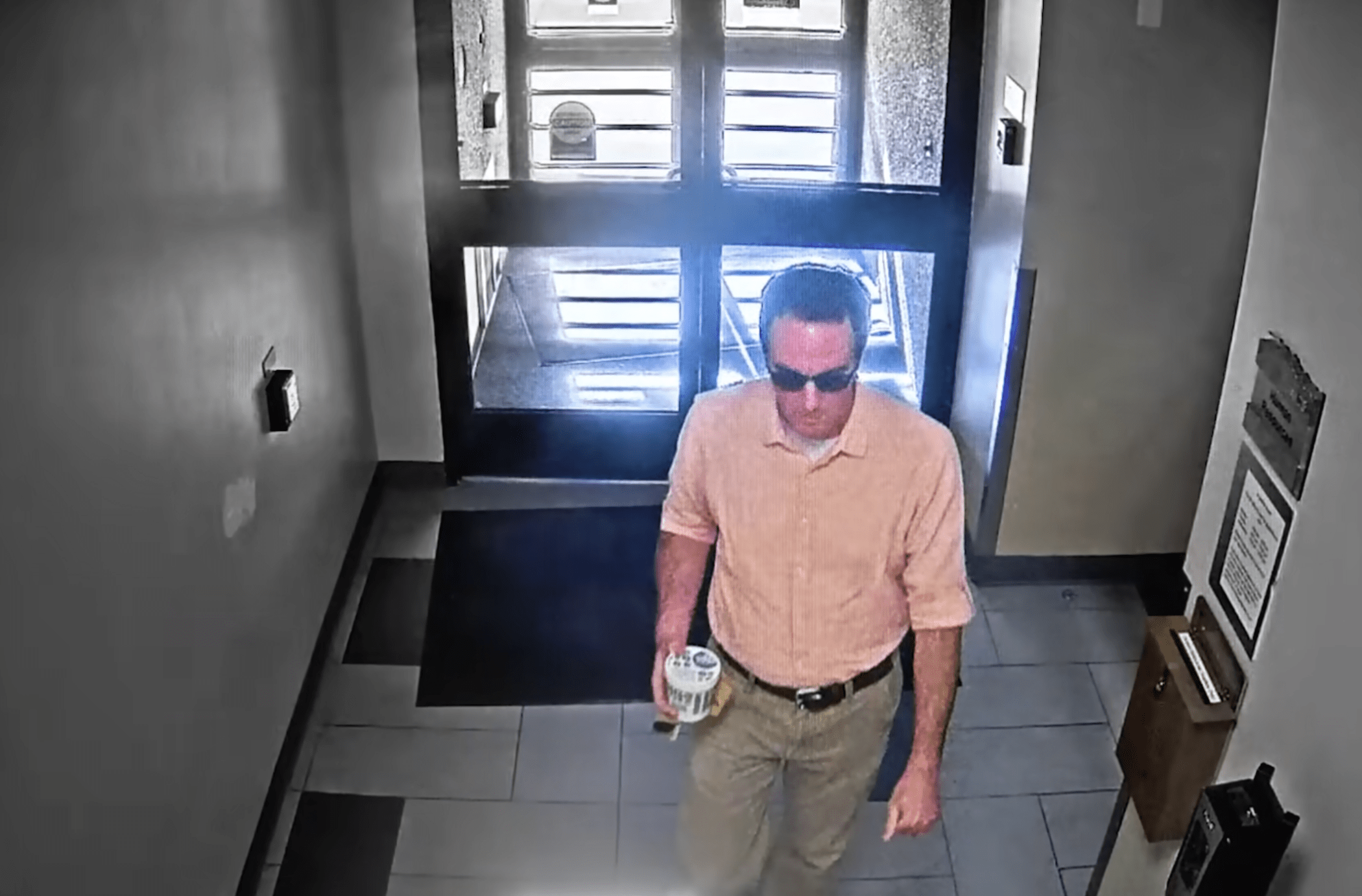
Attached was a photo of Daniel at his workplace.
The stalker wasn’t just coming for Crystal anymore. He was threatening her family.
Here’s what made Daniel’s plan so brilliantly sinister: he used a real person.
Anthony Holland actually existed. He had actually dated Crystal. He had actually contacted her inappropriately in the past (though harmlessly, years ago). Daniel didn’t invent Anthony—he just weaponized him. He turned a real person into a fictional monster, knowing that when police investigated, they’d find a real trail leading to a real human being.
And the details Daniel included? They were chillingly specific.
The photo of Daniel at work wasn’t taken by Anthony from Utah—it was taken by Daniel himself, probably asking a coworker to snap a casual picture, or using a timer. Then he sent it to Crystal from a burner phone, making it look like Anthony had traveled to Colorado to stalk them.
The mention of seeing Crystal at the dentist? Daniel knew her schedule. He lived with her.
The expired license plate comment? He saw her car every single day.
But here’s where Daniel’s background in fiction writing served him well: he understood character development. The “Anthony” persona evolved over time. He started crude and aggressive, then became increasingly obsessive and dangerous. By November, “Anthony” was sending messages suggesting Crystal was complicit in a plan to murder Daniel.
“We’re meant to be together and my family loves that we’re talking.”
Crystal shut it down hard, telling “Anthony” to stop. “He” became emotional and blocked her. She blocked him back and shut down her Facebook entirely.
This was psychological warfare—but not against Anthony. Against Crystal. Against the police. Against everyone.
Detective Andrew Martinez caught the case on October 31st, when Crystal finally called police. He was a seasoned investigator who’d worked abductions and violent crimes. He took Crystal seriously.
When he interviewed her, two things immediately stood out:
Martinez sent warrants to service providers requesting phone records, email logs, and account information. This is where the system failed Crystal. The companies were slow to respond—a delay that would prove fatal.
Meanwhile, Martinez interviewed Daniel about the September break-in. And that’s when something interesting emerged.
Daniel admitted that he didn’t know about the stalking for almost a month—not until Crystal showed him the email with his photo. Why the gap?
“She and I are going through a rough patch, kind of on the rocks,” Daniel explained. “It probably didn’t seem that pressing until I was in the picture.”
This was Daniel’s brilliance again. He was planting seeds of doubt about their marriage, creating a backdrop that would make Crystal seem potentially unstable or paranoid later if needed. He was building layers.
Daniel also played the terrified husband perfectly: “I have a retractable steel baton that I sleep with next to me. I’ve bought additional security cameras. I’m panicking and doing a shit job of protecting my wife. I’m not doing good.”
Oscar-worthy performance.
Throughout November, the harassment continued escalating. More messages. More threats. Crystal documented everything, constantly monitoring her cameras, living in a state of perpetual anxiety.
Then in early December, she received a message that made her breathe for the first time in weeks:
“Hey, gorgeous. I can’t visit you anymore. No more Colorado time. My girlfriend doesn’t want us talking without her. She says you’ll let the cops get me after you get rid of him.”
It sounded like Anthony was backing off, maybe even leaving the state. Crystal and her family felt a brief moment of relief.
This was Daniel’s final move before checkmate. He was making them drop their guard.
The morning started like every other morning. Daniel left for work. Crystal drove the kids to school. Everything normal.
Except Daniel had disabled the home security cameras at 8:15 a.m.—all of them except the one pointing at the outside of the garage. That camera would later prove crucial, but not in the way Daniel intended.
During the brief window when Crystal was gone, someone approached the front door and placed blue painter’s tape over the Ring doorbell camera. Then they slipped inside the house through an unlocked door.
When Crystal returned home at approximately 8:20 a.m., she pulled into the garage, stepped out of her car, and closed the door behind her.
Someone was waiting.
Daniel struck her in the head with a blunt object—hard enough to incapacitate her. Then he stabbed her in the chest, just above her heart. Crystal collapsed on the garage floor, bleeding, her concealed handgun still in her purse. She never even had time to reach for it.
The attack was brutal, personal, and filled with rage.
At 8:25 a.m., the outside garage camera captured Daniel leaving the house—later than he normally left for work, and shortly after medical examiners would determine Crystal died.
By 9:00 a.m., workplace surveillance showed Daniel moving through his office building, greeting coworkers, acting completely normal. As if he hadn’t just murdered his wife ten minutes earlier.
He went through his entire workday. Answered emails. Attended meetings. Played the part.
Hours passed. Daniel tried calling Crystal from his office. No answer. He sent texts. Nothing.
Finally, around midday, Daniel made the call.
“Hi there, my name is Dan Krug. I don’t think this is an emergency, but this feels really weird. My wife isn’t responding to text messages or phone calls. We’ve had threats against us. We’ve both been targeted by a stalker. Threats have been made against my life, and threatening to kidnap her, which is why I’m nervous that she’s not answering me.”
Perfect. Concerned husband. References the stalker. Establishes fear. All on record.
Daniel also called Crystal’s mother, Linda, asking her to check on her daughter. This move was particularly cruel—he was sending Linda directly into the worst moment of her life, knowing exactly what she’d find.
The officer arrived first. The house looked quiet. Nothing seemed wrong from outside. But something nagged at him, so he brought his patrol car closer to check the garage.
That’s when he saw her.
“151, send medical and 110. I need a sergeant. I got a female down in the garage.”
Crystal was lying motionless on the floor, blood smeared across the wall. The officer immediately began CPR, working on her for several minutes with no success. He opened the garage door to give medics access.
And that’s when Linda arrived.
As the garage door lifted, Crystal’s mother caught a brief glimpse inside—just long enough to see an officer performing CPR on her daughter’s body before another officer quickly shielded her away.
“Please, she’s okay,” Linda begged.
The officer couldn’t answer. Because she wasn’t.
Medics worked frantically, still trying to revive her, when one of them noticed something beneath Crystal’s clothing.
“What’s that? Gash on the chest.”
“Oh shit. That’s a stab wound.”
“Right above her heart.”
The scene immediately shifted from a possible accident to a homicide investigation.
When Daniel arrived at the scene, he delivered the performance of his life.
“MY HOUSE! THAT’S MY HOUSE!”
Officers guided him to where Crystal’s family was gathering, trying to calm him down. And there, in front of everyone, Daniel broke down.
“Oh my god. I didn’t protect her. I wasn’t here for her.”
Crystal’s mother, Linda, embraced him, trying to comfort the man she believed was a grieving husband. She had no idea she was holding her daughter’s killer.
The family stood together in shock and grief while Daniel played his role perfectly—the devastated spouse, the failed protector, the loving father now facing an unimaginable loss.
Meanwhile, officers were discovering details that didn’t add up.
The front door wasn’t deadbolted—just the handle was locked, and it opened easily when kicked. Blue tape had been carefully placed over the Ring doorbell camera. Whoever did this came prepared and planned it carefully.
And then came the detail that would later haunt the investigation: when officers checked the home security system on Daniel’s phone, they discovered that all cameras except one had gone offline at exactly 8:15 a.m. and stayed off until 10:15 a.m.
Why would a stalker know how to disable the security system from inside the house?
At the police station, detectives interviewed the family. And this is where Daniel’s carefully constructed narrative started showing fractures.
Crystal’s eldest daughter revealed something disturbing: the stalker had recently posted something online trying to recruit people to help him with “whatever plan he’s doing.” And he was making it sound like Crystal was helping him kill Daniel.
“We’re afraid the police are going to turn on us,” the daughter said.
Think about how twisted that is. Daniel had manipulated his own children into believing their mother was conspiring with a stalker to murder him. He’d poisoned their perception of Crystal in her final weeks alive, making them see her as a threat instead of a victim.
When detectives interviewed Crystal’s family members, a pattern emerged: everyone felt something was off about the stalking situation, but they couldn’t articulate what.
Crystal’s sister-in-law Kate said: “I just always felt like there was something weird about it. Crystal said it seemed very different than past behavior from Anthony—that he was never sexual in the past, and these were very hypersexual things. I think she was even questioning whether it was actually him.”
Crystal’s mother was even more direct. When asked about her suspicions, she said:
“I can’t shake this question: Is Daniel the one that’s been doing this with Anthony?”
Her son Lars dismissed it as conspiracy thinking. But mother’s intuition rarely lies.
That afternoon, police got their first real break. They located a possible address for Anthony Holland in Utah and coordinated with Utah County Sheriff’s Office.
When officers knocked on his door, they found Anthony intoxicated and confused. He hadn’t heard from Crystal in years—not since 2016, when she’d told him she was happily married and to stop contacting her. He’d blocked her, she’d blocked him, and that was that.
“When was the last time you talked to Crystal?” the officer asked.
“1999,” Anthony said, referring to when they’d dated. As for recent contact: “No.”
His timeline was simple: he’d been in Utah all morning with family, nowhere near Colorado.
Officers collected his statement and began verifying every detail. Within hours, they had surveillance footage showing Anthony in Utah at the time of the murder. No travel records. No license plate pings in Colorado. Nothing.
Anthony Holland wasn’t just innocent—he’d been completely unaware he was even a suspect in a murder plot.
While verifying Anthony’s alibi, Detective Martinez decided to dig into Daniel’s past. That’s when he found something chilling: an old, unresolved stalking complaint from years earlier.
The victim was a woman named Carrie—Daniel’s ex-girlfriend from college.
They brought Carrie in for an interview, and what she described was disturbingly familiar.
After she broke up with Daniel, she started receiving messages from his roommate “Tom” on AOL Instant Messenger. Tom’s role was to gain sympathy for Dan, to encourage Carrie to keep communicating with him, to suggest Dan was not doing well after the breakup.
“Tom ended up being Dan,” Carrie explained. “All these people I’m going to tell you about ended up being Dan Krug. Tom is a real person—Daniel’s actual roommate—but he wasn’t sending those messages.”
Then came “Nick Clark,” supposedly a cadet at the Air Force Academy. Nick told Carrie that guys she’d gone out with were spreading rumors that she’d slept with them, that she was “an easy target.” The purpose was to sabotage any new relationships she tried to form.
When Carrie started seriously dating an Air Force cadet named Mark Hansen, “Nick Clark” intensified his messages. He even set up a meeting for Carrie with the Office of Special Investigations at the Air Force Academy.
The OSI investigators laid out all the emails and told her: “We’ve had a forensic psychologist look at all these emails. It’s Dan.”
But there wasn’t enough evidence. Everything had been sent from public library computers. Carrie’s accusations remained just that—accusations.
The pattern was identical to what happened with Crystal:
Daniel had done this before. He’d practiced. He’d refined his technique.
And this time, he’d escalated to murder.
While Daniel thought he’d been clever, he’d made critical mistakes.
When the final round of digital evidence arrived, it was devastating:
1. The burner phones used to send threatening messages to Crystal were purchased with a Visa gift card registered under Daniel Krug’s name. He’d literally put his own name on the paper trail.
2. Cell tower records showed those burner phones were always in the same location as Daniel’s personal phone. He was carrying both devices simultaneously—the “stalker’s” phone and his own phone, side by side, everywhere he went.
3. The Gmail account “Kickman” that sent the photo of Daniel at work? It originated from an IP address at Daniel’s workplace. The stalker who was supposedly following Daniel had somehow accessed the wifi network inside Daniel’s own office building to create the account and send the threatening email.
4. Google search history from the night before the murder:
Daniel had researched his murder method less than 24 hours before killing his wife.
5. Surveillance footage from the neighborhood showed no one approaching the Krug home that morning. No mysterious stalker. No Anthony. Nobody.
But the outside garage camera captured Daniel leaving the house at 8:25 a.m.—10 minutes later than his normal departure time, and right after the window when medical examiners determined Crystal died.
When detectives brought Daniel back for a second interview, he walked in expecting routine follow-up questions. He had no idea how much had changed.
Detective Martinez opened gently, getting Daniel comfortable, talking about the marriage, the family dynamics, the stress of the stalking.
Daniel admitted: “I didn’t feel like a partner who valued me. I told her I didn’t want to die for someone who didn’t care about me anymore. What I wanted was for her to say she cared about me. She didn’t.”
There it was. Motive. Resentment. Rejection.
Then Martinez dropped the hammer.
“The Gmail account, the Kickman account you guys initially received with the photo of you in it? Both of those accounts originated from IP addresses that trace back to your office.”
Daniel looked thrown. “Doesn’t make any sense.”
“Well, he took the photo of me at my office.”
Martinez continued: “Let’s add on top of that the fact that, as far as we know right now, there’s no physical way that Kickman could have been involved in this based on where he’s at.”
Anthony had a rock-solid alibi. He was in Utah, severely intoxicated, six and a half hours away. There was no way he could have made the drive.
“We’ve been chasing the wrong dog,” Martinez said, watching Daniel’s face.
The detective then laid out a theory: “We might create an account to see if Crystal’s actually interested in Anthony. We push the bounds a little bit and see if that will confirm our suspicions of infidelity. You don’t get the response you want for about 28 days. Do you amp it up a little? Send a photo of yourself to her from an account you created?”
Daniel’s response was telling: “I get the narrative together, but it alleges that I would do this to my children.”
He didn’t deny the narrative. He just objected to what it said about him as a father.
Martinez delivered the kill shot: “I think ultimately what happened today would bring you the closest to your children that you’ve probably ever been—in your mind.”
Silence.
“You’re afraid to lose time with them if you get divorced.”
More silence.
Then the detective asked the most devastating question of all:
“If you were watching these facts unfold in front of you in a movie, what would you say happened?”
Daniel’s answer was weak: “There has to be someone else.”
But when Martinez pushed—asking Daniel to explain who else could have turned off the cameras, used his IP address, accessed his workplace wifi, carried burner phones alongside Daniel’s personal phone—Daniel had nothing.
“I don’t do crime drama. I don’t know what any of this is.”
Except he did. He was a fiction writer. He’d crafted this entire narrative. He’d created characters, built backstories, developed a plot with escalating tension. He’d written a thriller and tried to live inside it.
Martinez went for the truth: “I’d like to know what happened this morning. I’d like to know what caused you to get so upset, to hurt your wife. Because I believe that’s what happened.”
“There’s only one person in this room that can tell us.”
Daniel had had enough. “I’ve answered all your questions, but I guess you have your theory. Please find the right one. You’re done.”
The interview ended. But before he left, Daniel made one final plea:
“Don’t stop looking elsewhere. Focus on me, okay, but find— Are you married? You have kids? He took my children’s mother from them for Christmas.”
The audacity. The sheer, breathtaking audacity of a man who murdered his wife, blaming a phantom he created, while positioning himself as the grieving father.
But Daniel had slipped. He’d admitted something no one else knew: Crystal had confronted him directly, asking if he was the stalker.
That confrontation, Detective Martinez believed, was what pushed Daniel over the edge. Crystal had figured it out. She knew. And Daniel couldn’t let her expose him.
Over the next 48 hours, the case became airtight.
Utah officers confirmed Anthony’s alibi with surveillance footage, receipts, and witness statements. He hadn’t left Utah in months.
The complete digital evidence arrived:
There was no mystery stalker. There was no Anthony. There never had been.
It was always just Daniel.
On December 16th, 2024—just two days after Crystal’s murder—an arrest warrant was issued for Daniel Krug.
Officers found him on his way to his daughter’s dance performance. When patrol units moved in, Daniel appeared to be heading back toward his car. Officers thought he might try to run.
“GET ON THE GROUND! HANDS ON YOUR HEAD!”
Daniel Krug was taken into custody without incident.
The man who’d spent four months building an elaborate fiction, who’d terrorized his wife, manipulated his children, and framed an innocent man, was finally caught.
In April 2025, Daniel Krug stood trial for first-degree murder.
Prosecutors painted a devastating picture:
“This was about Dan losing control. He was not in love with Crystal. That resentment had turned to rage by December 14th. Think about what he did to her. You don’t do that to somebody you love. Think about the absolute nightmare and hell that he made the last few months of her life.”
The defense argued there was no physical evidence placing Daniel at the crime scene, that the case was purely circumstantial.
But the jury saw through it. After deliberating for nearly two days, they returned their verdict:
“We, the jury, find the defendant guilty of murder in the first degree.”
Daniel Krug was also convicted of stalking and criminal impersonation. He was sentenced to life in prison without the possibility of parole.
The Final Truth
Daniel Krug was a man so terrified of losing control that he chose to destroy everything rather than let go. He didn’t love Crystal—he loved the idea of his family, the image he projected, the control he wielded.
When Crystal told him it was over, when she said she’d stay until their daughter graduated but the marriage was dead, Daniel couldn’t accept it. So he built a monster out of shadows and used it to terrorize the woman he claimed to love.
And when Crystal started to see through the illusion, when she confronted him and asked if he was behind it all, Daniel made his final move. He took her life. He took his children’s mother. He took everything.
All because he couldn’t accept the one thing he couldn’t control: someone else’s choice to leave.
The most chilling part? He almost got away with it. If the tech companies had responded faster to the initial warrants, if Detective Martinez had received that digital evidence in November instead of December, Crystal might still be alive.
But Daniel’s plan had one fatal flaw: he was too smart for his own good. He over-engineered it. He left too many digital breadcrumbs. And in the end, his own cleverness became the rope that hanged him.
Three children lost their mother. Not to a mysterious stalker. Not to a random act of violence.
To their own father’s obsession with control.
That’s the real horror of this story.