Physical Address
304 North Cardinal St.
Dorchester Center, MA 02124
Physical Address
304 North Cardinal St.
Dorchester Center, MA 02124

How a 14-year-old turned internet memes into six-figure monthly revenue—and what you can learn from his distribution-first approach
At 14 years old, Raphael Kramer did something most entrepreneurs only dream about: he made over $100,000 in a single month. His secret weapon wasn’t venture capital, a revolutionary technology, or even a team of developers. It was a simple game about a rapper’s head photoshopped onto a car—a fleeting internet meme that most people scrolled past without a second thought.
While others were laughing at memes, Raphael was building businesses around them. Over the past several years, he’s created more than 50 apps, accumulated over 100 million social media views, and completed three successful exits. His journey offers a masterclass in what he calls “viral trend sense”—the ability to spot cultural moments before they peak and turn them into profitable products before the market gets saturated.
Raphael’s entrepreneurial journey began in the most relatable way possible: boredom during the COVID-19 pandemic. At 13 years old, stuck at home with nothing but time and a smartphone, he searched YouTube for “how to make money.” He stumbled upon videos about the mobile game business and thought, “Why not?”
What happened next is a testament to the power of lowering barriers to entry. Raphael didn’t spend months learning to code. Instead, he used no-code tools like Buildbox to create his first games. This decision—prioritizing speed over technical perfection—would become a defining principle of his entire strategy.
“I used no-code tools in the beginning, which made it a lot easier as a 13-year-old kid who had zero coding experience,” Raphael explains. “I wasn’t a product guy. I just wanted to market stuff. That’s what I’m good at.”
In 2020, a bizarre meme started circulating on TikTok: the rapper DaBaby’s head photoshopped onto various cars. Most people found it funny for a few seconds and moved on. Raphael saw an opportunity.
“I saw it on my phone the day it released,” he recalls. “Then I just thought, ‘I’m going to pull an all-nighter, make a game about this, put it on the App Store, and promote it on TikTok.'”
Within 24 hours, he had created a simple racing game featuring DaBaby’s iconic head-car hybrid. He already had a TikTok following of a few hundred thousand, built from previous projects. He posted one video about the game. It went viral.
The results were staggering:
The monetization strategy was brutally simple: Google AdMob ads. Every second time a player died, an ad would appear. Want to revive and continue playing? Watch a 30-second ad. No in-app purchases, no complex monetization schemes—just straightforward ad revenue at roughly 10 cents per user.
Raphael’s success with the DaBaby game wasn’t luck. It was a repeatable system he had been refining with each attempt. His playbook consisted of four critical steps:
The key wasn’t jumping on massive trends—it was identifying them before they peaked. Raphael developed an intuitive sense for what would explode by being deeply embedded in the same social media ecosystems as his target audience.
“I would find something that pops off, find it early, make a game, put it on the App Store, and then make videos about it and hope they go viral,” he explains.
Raphael’s insight was that a meme is inherently two-dimensional—you see it, laugh, and scroll. But if you can make it interactive, you’ve created something more shareable and engaging.
“A trend is kind of like 2D, right? You see it, you laugh at it, you scroll. But if you can actually interact with it, you can actually be DaBaby in a game—that’s just much more funny and people will automatically share that.”
In the world of viral trends, timing is everything. A meme’s peak might last only days or weeks. Raphael would often pull all-nighters to get games to market while the trend was still hot. This is where no-code tools became essential—not because he couldn’t code, but because speed was the only competitive advantage that mattered.
Raphael didn’t rely on paid advertising in the beginning. Instead, he created “dev log” videos showing the process of building games around trending memes. These meta-videos performed exceptionally well because they combined multiple viral elements: the trending meme itself, the behind-the-scenes creation process, and a playable product.
His TikTok strategy evolved over dozens of iterations. He A/B tested hooks, analyzed which frames to show, and discovered that starting with phrases like “Making a game about DaBaby” or “Making a game about the Vegan Teacher” immediately grabbed attention because they referenced things already trending.
While TikTok provided the initial spark, Raphael discovered that organic sharing drove the majority of downloads. The DaBaby game got approximately 300,000-400,000 downloads from his first few TikTok videos. The remaining 1.6+ million downloads came from a powerful combination of factors:
App Store Chart Positioning: Hitting #2 overall and #1 in racing meant millions of people browsing the App Store saw DaBaby’s face staring at them from the charts. Curiosity drove instant downloads.
Word-of-Mouth in Schools: Middle schoolers and high schoolers would play during lunch breaks, show friends, and challenge them to beat their high scores. This created a viral loop within the target demographic.
The K-Factor: Each user who enjoyed the game shared it with multiple friends, creating exponential growth that far exceeded the initial TikTok views.
“The K-factor had much more of a role than the actual TikToks,” Raphael notes. “People would show it to their friends, their friends would try to beat their high scores, they would see it on the top charts—that’s how it spread like wildfire.”
After successfully executing this playbook dozens of times with his own games, Raphael had a realization: he could scale this model by partnering with influencers who already had massive audiences.
At 15, he founded a company that helped influencers launch their own games. The business model was elegant: 50/50 profit sharing, with Raphael’s team handling all the development and launch logistics while influencers provided distribution through their established audiences.
The company grew to 10 employees and landed some significant partnerships. The biggest was with the creator of Skibidi Toilet, a massively viral YouTube channel with over 50 million subscribers (though it had about 5 million when Raphael first reached out).
“He literally did one YouTube Shorts promotion. He made one video on the game and that got more than 50 million views. That drove a bunch of downloads, and then from there it was also word-of-mouth.”
The Skibidi Toilet game achieved 2-3 million downloads in its first two weeks. Though the game was eventually taken down for undisclosed reasons, it demonstrated the power of the influencer partnership model.
Raphael sold this company at age 17 for at least six figures.
Through dozens of influencer partnerships, Raphael developed a refined approach to cold outreach that achieved remarkably high response rates. His strategy goes far beyond sending templated DMs.
“The most important part is positioning yourself as one of them almost,” Raphael explains. His approach involved:
This positioning made influencers see him as a peer rather than just another person asking for something.
Not all influencers are created equal for app partnerships. Raphael learned this the hard way when a collaboration with a 5-million-follower influencer who regularly got 2 million views per video resulted in a complete flop.
The key insight: follower count and even engagement metrics don’t guarantee successful app launches. Instead, Raphael looks for:
Active Communities: Are people commenting substantively and responding to each other, or just dropping emoji reactions?
Content That Translates to Interactive Experiences: Does the influencer have inside jokes, a created universe, or recurring elements that could become game mechanics?
Audience Investment: Do followers care about the influencer’s projects, or do they just passively consume content?
For the Skibidi Toilet collaboration, the fit was perfect. The creator had built an entire universe with characters and storylines that existed only in video format. Fans were deeply invested but had no way to interact with this world. A game was the natural extension.
After executing the meme-game playbook nearly 50 times, Raphael hit a ceiling. “I’ve never been a product guy. I just want to market stuff. That’s what I’m good at,” he admits. “I can clearly get downloads, I can clearly get views, I can clearly do the marketing side. I’ve just never had a good product.”
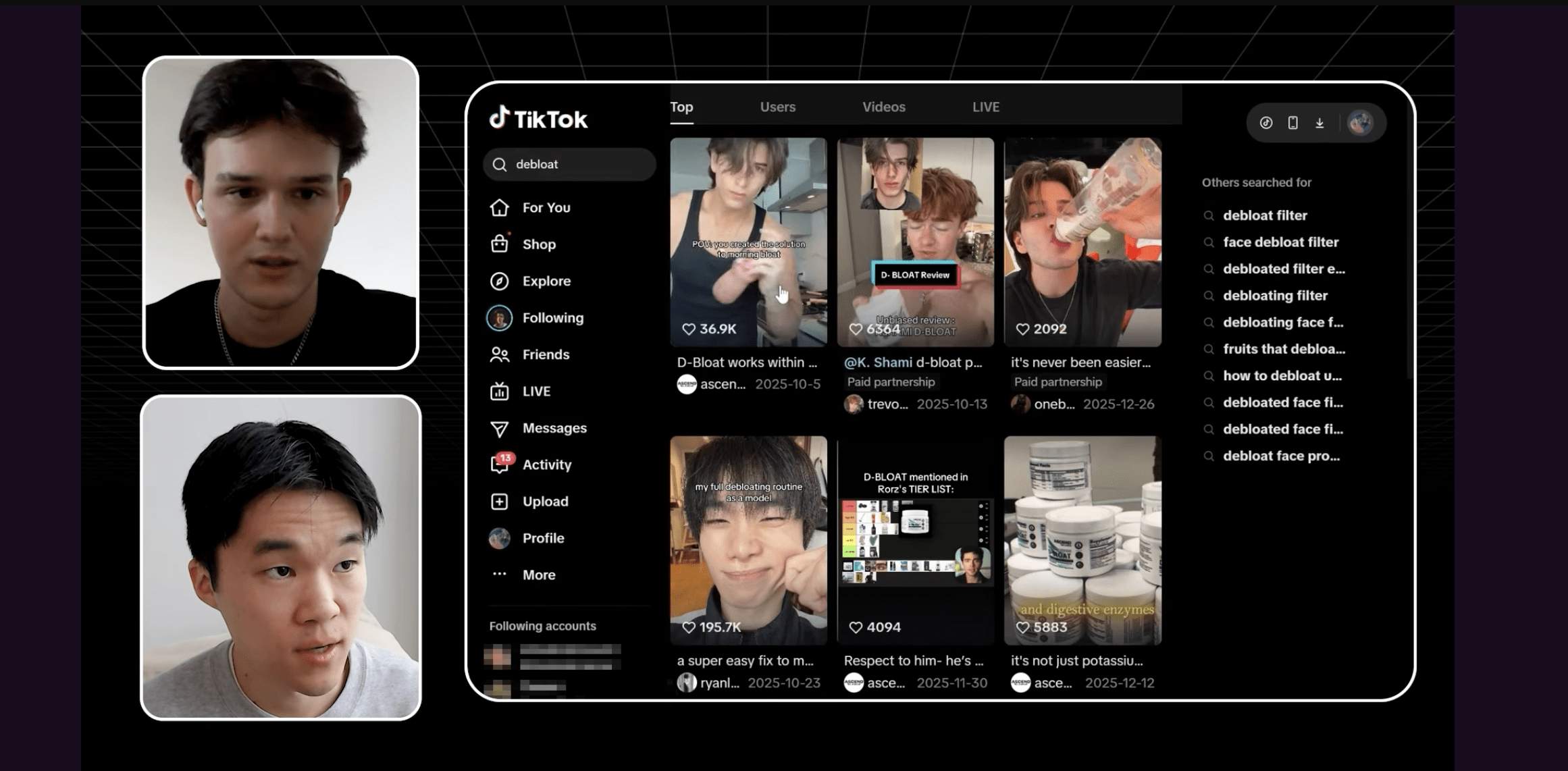
In 2025, he made a strategic pivot to consumer apps, starting with a “debloating” app called Deblo AI. This shift was driven by several realizations:
Lower Product Barriers: Consumer apps don’t require 3D animations, complex graphics, or game mechanics. They just need to solve a problem effectively.
Better Retention Potential: While his games were designed for virality over retention, consumer apps could build sustainable user bases.
More Meaningful Impact: As he matured, Raphael wanted to build products he’d be proud of long-term, not just clever viral plays.
The idea for Deblo AI came from Raphael’s own social media consumption. He noticed a massive amount of content about facial debloating, with TikTok videos showing dramatic before-and-after transformations. In the comments, hundreds of people were asking, “How do I debloat?”
The market was there—people were buying e-commerce products and supplements promising debloating results but were skeptical of pills and powders. An app-based solution didn’t exist.
Raphael’s approach combined several innovative elements:
Face Scanning Before Paywall: Users would take a photo and receive a (slightly exaggerated) rating showing how bloated they were. This created a sunk cost fallacy—users had already invested time and seen their “problem,” making them more likely to pay for the solution.
Social Proof and Psychology: The onboarding emphasized the problem (insecurity about bloating) before presenting the solution, playing into the same emotional drivers that made the TikTok content viral in the first place.
Multi-Channel Distribution:
The app achieved 40,000 downloads, with particularly strong early economics—paying just a few cents per download before competition saturated the market.
For Deblo AI, Raphael didn’t create content himself. Instead, he hired a network of content creators to run faceless accounts—pages that posted slideshow-style content without showing anyone’s face.
The economics were compelling: “We would pay these guys not a lot at all. So it was basically free installs compared to what we paid them, and they were incentivized to figure out how to get views on their own. We would just pay them on a CPM basis.”
This approach offered several advantages:
Scalability: Multiple accounts could post simultaneously, testing different angles and content styles.
Low Risk: Unlike working with established influencers who charge high fees, these creators were paid based on performance.
Skill Development: The creators were motivated to improve their viral content skills since their income depended on views.
Finding these creators was largely word-of-mouth. Raphael connected with a friend running a similar strategy for a different app and asked for introductions. The network effect took over from there.
Raphael’s most recent project showcases just how far the trend-riding playbook can be pushed. He’s launching another looks-maxxing app, but this time partnering with hyper-realistic AI influencers that most viewers believe are real people.
“When I first saw this influencer, I thought it was real,” he admits. “This is AI, which is pretty crazy. These guys run accounts that people don’t even know are AI. You can see in the comments people asking, ‘How did you do this transformation?'”
The strategy is to leverage these AI personas for distribution while the content is still novel and audiences haven’t caught on. It’s trend-riding at its most meta—using artificially generated viral content to promote an app about physical transformation.
Raphael’s journey from 13-year-old hobbyist to serial entrepreneur offers several counterintuitive insights:
“I can clearly get downloads, I can clearly get views. I’ve just never had a good product.” This honest self-assessment reveals an important truth: for certain types of apps, especially in the early stages, distribution capability matters more than product quality.
This doesn’t mean product doesn’t matter—Raphael explicitly says his next big swing will focus on building a truly great product. But it does mean that founders should honestly assess their strengths and play to them.
Raphael’s willingness to pull all-nighters and launch imperfect products while trends were hot gave him a decisive advantage. Many founders spend months perfecting features while the market opportunity evaporates.
“Speed was the only thing that mattered,” he explains about his no-code approach. “I wasn’t a product guy. I just wanted to get it out there.”
Raphael’s success with meme games came partly from being exactly the same age as his target users. “I genuinely would have downloaded that game myself if I would have seen it on my For You page,” he says.
But he also recognizes this as both a strength and a limitation: “There’s a lot of untapped potential for making apps for boomers or certain problems that the average founder couldn’t put themselves in those shoes for. I don’t think a lot of app founders are obsessed with keeping their garden nice and watering their plants, but there’s an app for that that probably makes $3 million a month.”
The key is either building for yourself or developing the empathy to truly understand your users’ psychology.
Raphael made six figures in a month with the simplest possible monetization: ads after every other death, ads for revival. No in-app purchases, no complex funnels. Sometimes simple is enough, especially when you have volume.
When working with influencers, Raphael found that making them feel like true partners—through regular updates, incorporating their ideas, and genuine 50/50 splits—dramatically increased their commitment and output quality.
“Really making them feel like it’s their game—let them give ideas, have weekly calls, send character updates. Let them feel like this is something they’re launching, which at the end of the day it is.”
Throughout the interview, Raphael repeatedly mentions looking at comment sections to understand problems, gauge interest, and assess influencer fit. “If you would see a transformation video of a guy bloated before and then not bloated after, there would be 100 people in the comments asking how. That’s a really good indicator of how strong a problem is.”
Raphael’s specific tools have evolved—from Buildbox to Unity developers, from personal TikTok to faceless UGC accounts, from real influencers to AI ones. But the underlying principles remain constant: find trends early, build interactive experiences, launch fast, and amplify through distribution.
One underappreciated aspect of Raphael’s success is his content creation skill. He wasn’t just building apps; he was building them in a way that created compelling content about the building process itself.
His TikTok “dev log” videos served multiple purposes:
This meta-content approach is increasingly valuable. The founder who can create engaging content about their product development has a built-in distribution channel that compounds over time.
Despite his youth, Raphael has hired and fired enough people to develop clear principles:
For Editors: “I don’t look for someone who can do good captions or good motion graphics. It’s more like, can you make a video that is entertaining and people want to watch?”
For Content Creators: “Something people sleep on is just getting a couple high school guys that want to make some extra money and teaching them how to make these slideshows. You just have to find someone who doom scrolls—they could probably make viral content themselves without even knowing.”
For Partners: Look for talent and motivation, then figure out how they fit. “Any sort of talent and we’ll figure it out.”
This philosophy of hiring for raw ability and teaching specific skills is particularly relevant for viral marketing, where institutional knowledge is limited and the landscape changes rapidly.
After years of building what he admits were “cash grabs,” Raphael is preparing for his most ambitious project: a wellness and mental health app that he’s genuinely passionate about.
“I don’t want to be 25 saying, ‘Oh yeah, I’m the founder of a Skibidi Toilet mobile game.’ It’s cool when you’re 15 or 14, but I know how to do marketing now. I know the app space now. My next app is going to be my very big swing.”
This evolution is natural and instructive. The skills developed through rapid iteration on “smaller” projects—distribution expertise, influencer relationships, content creation, user psychology—become the foundation for more meaningful work.
Perhaps the most honest insight from Raphael’s story is this: most of his products weren’t great. They weren’t designed to be. They were designed to go viral, generate downloads, and monetize quickly before the trend died.
“We never really cracked retention. That was never the strong suit. It was always the distribution edge,” he admits.
This approach has obvious limitations for building enduring businesses, which Raphael openly acknowledges. But it’s also how he developed rare skills in distribution and viral marketing that most founders lack.
The question for any founder is: What are you optimizing for right now? If it’s learning distribution and generating cash flow, Raphael’s playbook works. If it’s building a sustainable, defensible business from day one, you’ll need a different approach.
Raphael Kramer’s journey from 13-year-old pandemic-bored kid to multi-exit entrepreneur demonstrates a profound truth: in today’s attention economy, distribution expertise is a transferable superpower.
He turned memes into money not through revolutionary products or massive capital but through a repeatable system:
As he prepares for his next chapter—building products he’s truly proud of—he’s carrying forward the hard-won lessons from 50+ app launches. The viral trend sense he developed through relentless iteration is now being applied to problems that matter.
For founders and marketers, the lesson is clear: you can learn distribution. It requires being deeply embedded in your audience’s world, moving with uncomfortable speed, and iterating until you develop an intuitive sense for what will spread.
The memes may be fleeting, but the skills last forever.